
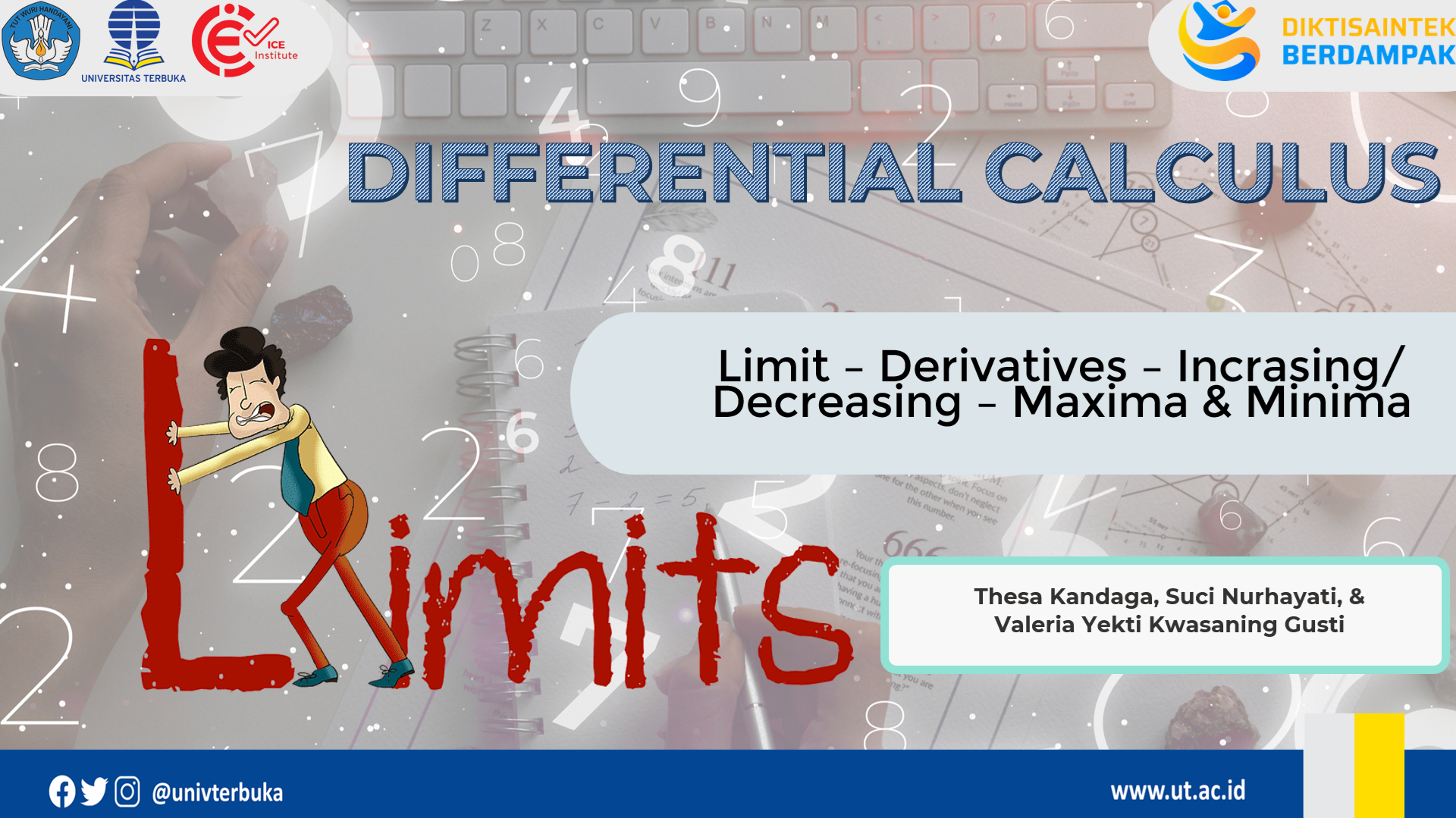

Course Description
This course introduces the fundamental concepts of differential calculus—the mathematics of change. It begins with the idea of limits, which form the foundation for understanding how functions behave near specific points. Limits are essential for defining continuity and preparing for the concept of instantaneous change. The course then explores derivatives, which measure how one quantity changes in relation to another. From velocity to cost, derivatives provide powerful tools to analyze real-world rates of change. You will learn differentiation rules and interpret derivatives both graphically and algebraically. With these tools, you will investigate increasing and decreasing functions, determine where functions rise or fall, and identify critical points for analyzing maximum and minimum values—crucial for solving optimization problems in science, economics, and engineering. By the end of the course, you will be able to model dynamic systems, interpret change precisely, and apply differential calculus confidently to practical problems.
Learning Outcomes
After completing this course, students are expected to be able to:
- Understand and apply the concepts of limits and continuity to real-world functions.
- Compute derivatives of various types of functions using differentiation rules.
- Interpret the meaning of derivatives in real-world contexts such as velocity, cost, and growth rate.
- Use the first derivative to determine intervals where a function increases or decreases.
- Identify and analyze critical points, and determine local and global extrema for optimization problems.
- Apply differential calculus to model dynamic systems and solve practical problems in science, economics, and engineering.
Topics / Materials
- Introduction to the concept of change and motivation for calculus
- Limits: definition, computation, and applications
- Continuity of functions and its relation to limits
- The derivative: definition, geometric and physical interpretation
- Differentiation rules for polynomial, rational, exponential, logarithmic, and trigonometric functions
- Applications of derivatives: velocity, acceleration, marginal cost/revenue
- First derivative test for analyzing increasing/decreasing behavior
- Critical points and extrema (local/global maxima and minima)
- Optimization techniques and modeling with derivatives
- Introduction to dynamic systems and continuous change
- Case studies and real-world applications in economics, engineering, and science
Course Developers

Dr. Thesa Kandaga, S.Si., M.Pd.
[email protected]
Dr. Kandaga is a mathematics education lecturer affiliated with Universitas Terbuka. He serves on the editorial board of Hexagon: Jurnal Ilmu dan Pendidikan Matematika and Education and has numerous publications in mathematics education research. Her works often focus on pedagogical strategies and digital tools to enhance conceptual understanding in mathematics.

Suci Nurhayati, M.Pd.
[email protected]
Suci Nurhayati is a lecturer in Mathematics Education at Universitas Terbuka. Her academic interests include online mathematics learning, self-efficacy in distance education, and the integration of technology in mathematics instruction. She is actively involved in research and development of digital learning models for open and distance education systems.

Valeria Yekti Kwasaning Gusti, M.Pd.
[email protected]
Valeria Yekti Kwasaning Gusti is a lecturer and researcher at Universitas Terbuka. She serves as an editorial team member for the International Journal of Research in STEM Education. Her research explores game-based learning, mathematical literacy, and innovative approaches to STEM education using interactive media.