Course Introduction
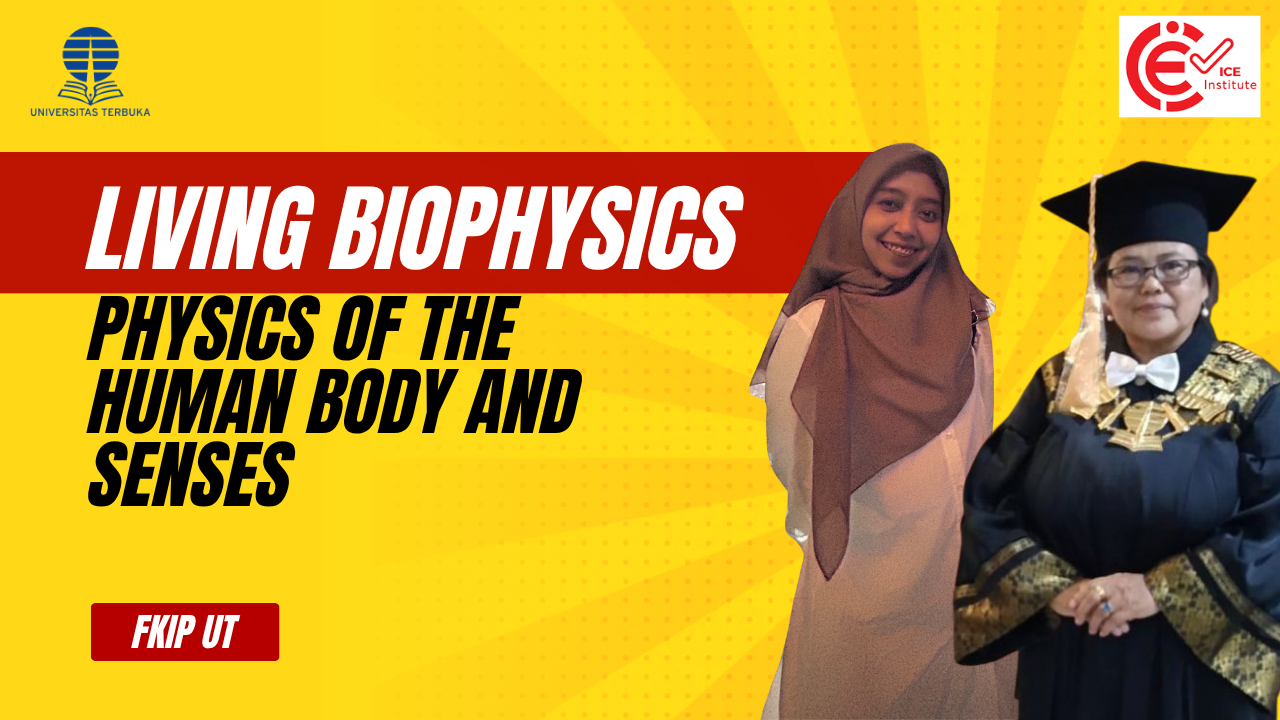
Living Biophysics – Physics of the Human Body and Senses
Have you ever wondered how your muscles generate movement, how your nerves send electrical signals, or how your eyes and ears translate light and sound into perception?
This course, Living Biophysics: Physics of the Human Body and Senses, takes you on an exciting journey to uncover the physics behind life itself — exploring how fundamental physical principles shape the structure and function of the human body.
About This Course
Biophysics bridges the gap between biology and physics — explaining how living systems work through the language of forces, energy, and motion.
In this course, you will explore how physical principles govern biological functions — from the microscopic scale of cells and molecules to the macroscopic processes of motion, sensation, and neural communication.
Through six interactive sessions, you’ll examine how mechanics, electricity, and wave physics explain the living world — helping you connect classroom science with real-life biological phenomena.
What You Will Learn
By the end of this course, you will be able to:
- Explain the biophysical basis of cell structure, membranes, and molecular transport.
- Describe how proteins, DNA, and RNA function as the molecular machinery of life.
- Apply the principles of mechanics and fluid dynamics to understand body movement and blood circulation.
- Analyze how bioelectricity enables communication between neurons and triggers muscle activity.
- Explore how light and sound waves are perceived through the physics of hearing and vision.
- Recognize how biophysical understanding leads to innovations in medicine, biotechnology, and neuroscience.
Who Is This Course For?
This course is designed for:
- Undergraduate students or teachers in physics, biology, or health sciences seeking interdisciplinary insight.
- Lifelong learners interested in understanding how the laws of physics operate in living systems.
- Educators and professionals looking for conceptual frameworks to integrate biophysics into their teaching or research.
No advanced mathematics background is required — just curiosity about how nature works at every scale of life.
Why Take This Course?
Interdisciplinary Perspective: Learn how physics and biology converge to explain life processes.
Real-World Relevance: Discover applications in health, medicine, and modern technology — from blood flow modeling to mRNA vaccines.
Engaging Learning Design: Enjoy interactive visuals, discussion forums, concept maps, and real-world examples.
Human-Focused Approach: Every topic connects biophysical theory to human experience — motion, perception, and thought.
Course Structure
This course is organized into six sessions, each focusing on a key biophysical concept:
- The Living Cell: Structure and membrane function
- Proteins: The shape of function in life
- DNA and RNA: The blueprint of genetic information
- Mechanics & Fluid Flow: The forces behind motion and circulation
- Bioelectricity: Signals and communication within the body
- Hearing and Vision: The physics of sound and light perception
Each session includes readings, videos, quizzes, discussions, and concept maps to help you learn actively and reflectively.
Learning Approach
This course combines conceptual explanation, visual learning, and problem-based inquiry. You’ll engage with materials through:
Reading materials and animations to build understanding
Discussion forums to exchange insights with peers
Interactive quizzes and concept maps to strengthen comprehension
Join the Journey
Whether you’re a student, educator, or science enthusiast, this course will help you see life through the lens of physics— revealing how invisible forces shape everything from cellular processes to human senses.
Let’s discover together the physics that makes life possible.
Learning Outcomes
Before we begin, let’s take a look at what you’ll achieve in this course!
Through a series of interactive lessons, real-life examples, and engaging visuals, you’ll explore how physics explains the living world — from the smallest cells to the human senses.
By the end of this course, you will be able to:
- Explain the biophysical principles that govern the structure and function of cells, membranes, and biomolecules.
- Describe and differentiate the molecular architecture and roles of proteins, DNA, and RNA in maintaining life processes.
- Analyze the application of mechanical and fluid dynamic principles in understanding body motion, blood flow, and pressure systems.
- Interpret the mechanisms of bioelectricity, including neural signal transmission and muscle activation.
- Explore how light and sound waves are transformed into sensory perceptions through the physics of hearing and vision.
- Integrate concepts from physics and biology to explain how physical laws shape living systems at both microscopic and macroscopic scales.
- Apply biophysical reasoning to everyday phenomena and emerging innovations in health, medicine, and biotechnology.
Meet the Instructor
1. Dr. Widiasih, M.Pd. (Email: w[email protected])
I am currently serving as the Head of Study Program in Physics Education, FKIP UT. My expertise lies in science education, particularly in biophysics. My academic focus includes developing innovative learning models, promoting scientific literacy, and integrating technology into science teaching. I am actively involved in research, publications, curriculum development, and community service to enhance the quality of science education in Indonesia. Through these activities, I aim to empower future teachers and contribute to meaningful improvements in education.

2. Rika Aprianti, M.Pd. (Email: rika.aprianti@ecampus.ut.ac.id)
Hello everyone! I am a lecturer in the Physics Education Study Program at Universitas Terbuka. Before joining UT in 2022, I taught physics at junior and senior high schools in both national and international settings. Those experiences shaped my passion for inclusive and engaging science learning with students from diverse backgrounds. My academic interest focuses on interactive and technology-assisted learning media—resources that make distance and independent learning more accessible, motivating, and fun. I believe that with the right design, physics can feel close to daily life and empowering for every learner, wherever you are. In this course, we will learn together, share ideas, and explore how biophysics connects to real classrooms and real life. I’m excited to meet you all and support your learning journey!